
 Free delivery on orders over 100 €



Safety — lit paths, steps and entrances
The first job of any outdoor lighting is keeping people upright. Dark paths and unmarked steps are the commonest cause of falls after dark. Well-planned path lighting and step lighting removes that risk without turning the garden into a car park.
The principle is that every fitting should have one job. A path light throwing light downwards, LED units set into the risers of steps, a wall light beside the front door — each solves a specific visibility problem, and together they cost less light than one badly aimed floodlight.
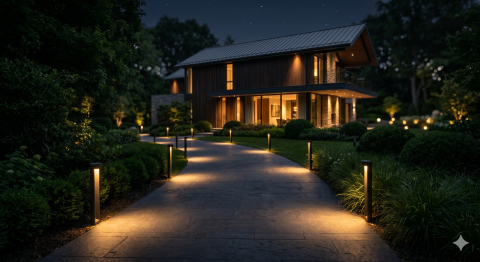
When choosing fittings, check the IP rating first: IP44 as a minimum for covered terraces, IP65 for exposed facades and paths, IP67 to IP68 anywhere in direct contact with water. If you are unsure which rating a particular spot needs, ask us — it is a five-minute conversation that saves replacing a fitting after one winter.
- Bollard lights along a path every 180–220 cm for even coverage
- LED units recessed into steps — light aimed at the tread itself
- LED strips along handrails and kerbs to mark the edges
- Wall lights at the front door — wide beam, IP65
- Recessed in-ground fittings for paths and driveways, rated to take weight
Security — sensors, timers and smart control
A well-lit perimeter is a genuine deterrent. Security lighting on PIR motion sensors works better than lighting that simply stays on, because what draws attention is the change, not the brightness.
„Light that appears when something moves is far more effective than light that burns all night. It marks a change, and a change is what gets noticed."
Modern smart lighting systems give you full control from a phone, including when you are away. You can set a schedule, switch on an away mode that mimics someone being at home, or connect the lighting to Google Home, Amazon Alexa or Apple HomeKit.
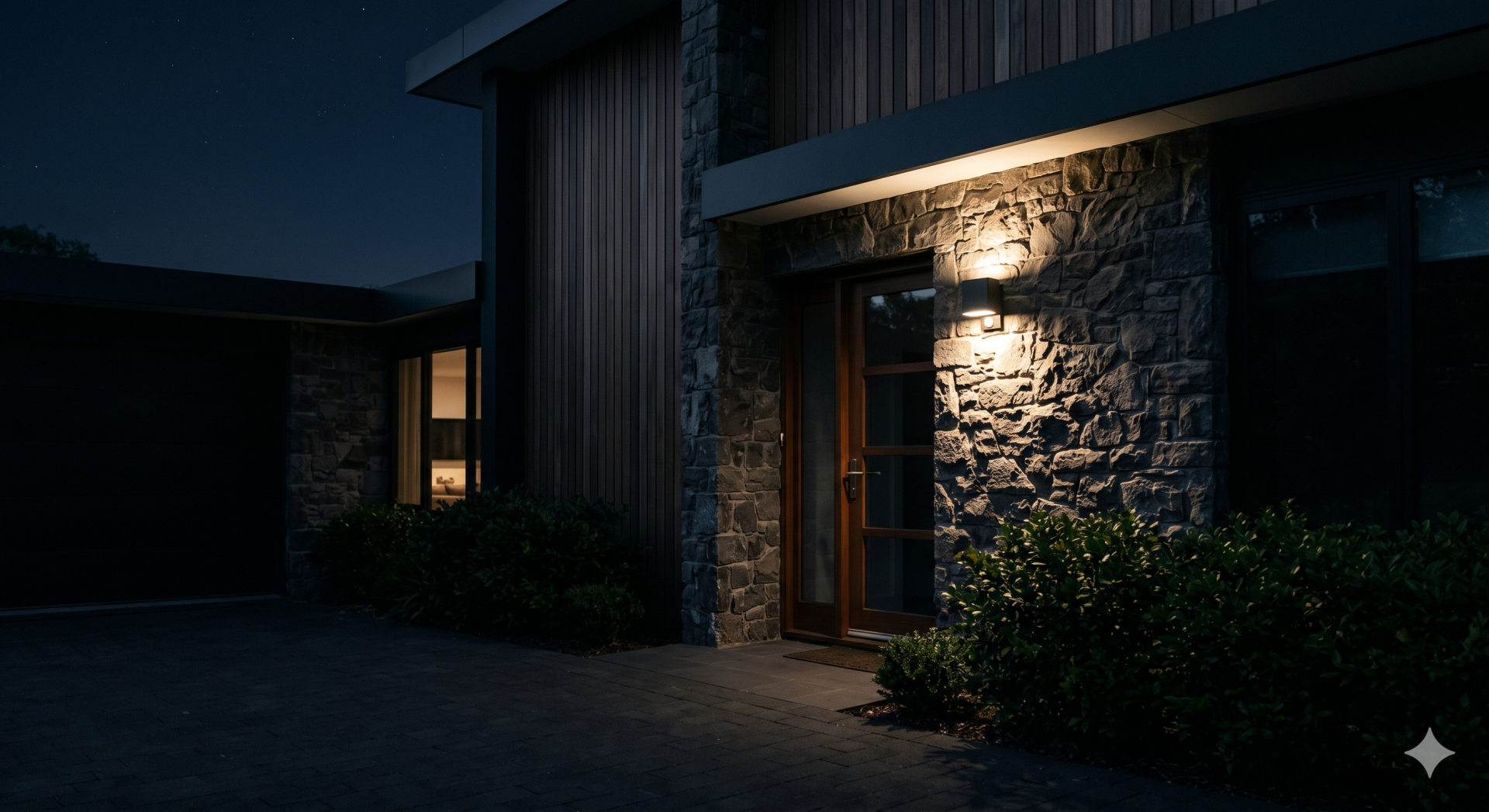
- PIR sensors — adjustable detection angle and sensitivity
- Photocells — on at dusk, off at dawn, with nothing to set
- Astronomical timers — synchronised to sunrise and sunset for your location
- Wi-Fi or Zigbee control — operated from a phone, wherever you are
- Floodlights with a built-in sensor — ideal for a garage or a side entrance
Layers — how light gives a space its shape
After dark your garden and your facade exist only as far as the light reaches. That makes decorative garden lighting one of the strongest tools in landscape design. The principle of layering — ambient, task and accent light used together — is what separates a scheme that looks designed from one that looks merely switched on.
You do not need to light everything. A few chosen focal points — a tree, a sculpture, a water feature, an architectural detail — create depth and drama. It is the contrast between lit and unlit that makes a space interesting; light everything evenly and you flatten it.
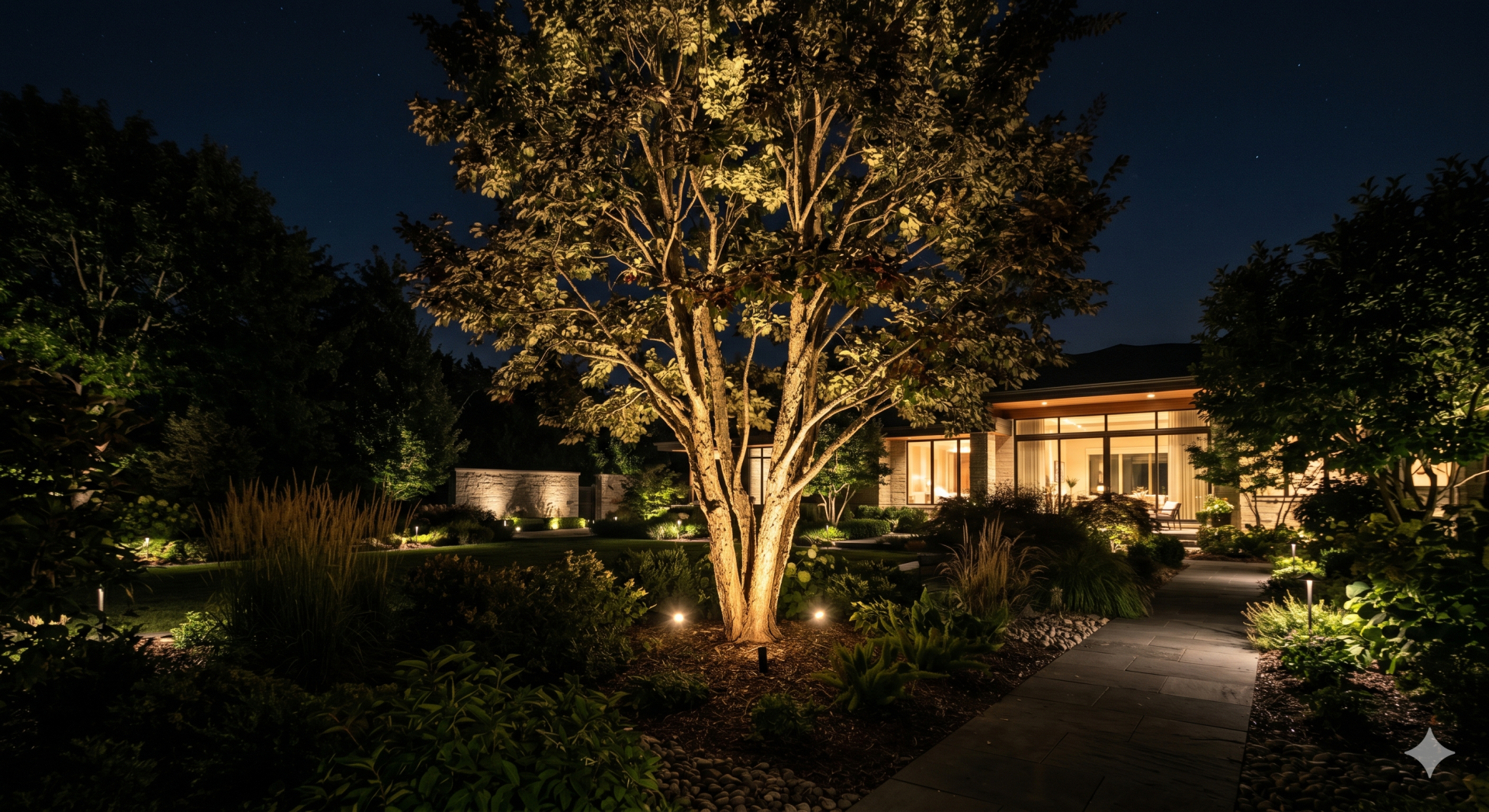
- Uplighting — light from below; brings out trees, columns and detail
- Grazing — light at a sharp angle along a wall; reveals the texture of stone and brick
- Moonlighting — a fitting up in a tree, throwing soft dappled light downwards
- Underwater fittings — for fountains and ornamental ponds; IP68
- Outline lighting — LED strips following the architectural lines of a building
Our outdoor range covers LED floodlights, bollards, recessed in-ground fittings and a full choice of garden and facade lighting from established European manufacturers.
How you live outdoors — terraces, dinners and places to sit
A well-lit terrace makes the house bigger. Instead of going indoors at sunset you carry on outside — dinner, a drink, or simply sitting out. Lighting is the whole of the difference.
For eating and sitting areas, make it dimmable. Being able to go from working brightness to something much lower, with one control, is worth more than any single fitting. A pendant over the table plus LED strip along the terrace rail is a combination that is hard to better.
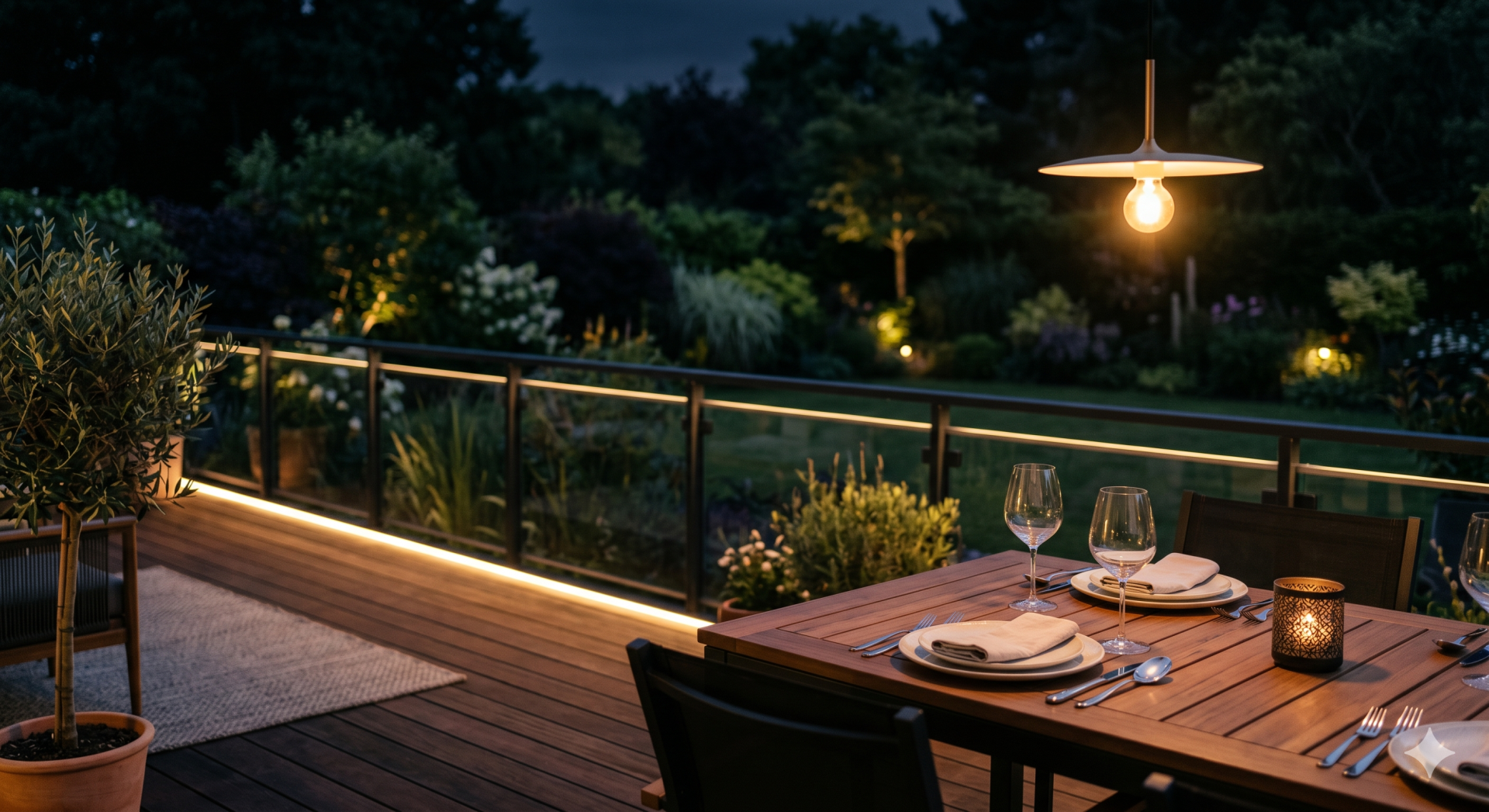
- An outdoor pendant — the accent over a dining area; IP44 as a minimum
- LED strip along a rail — soft light marking the edge of the terrace
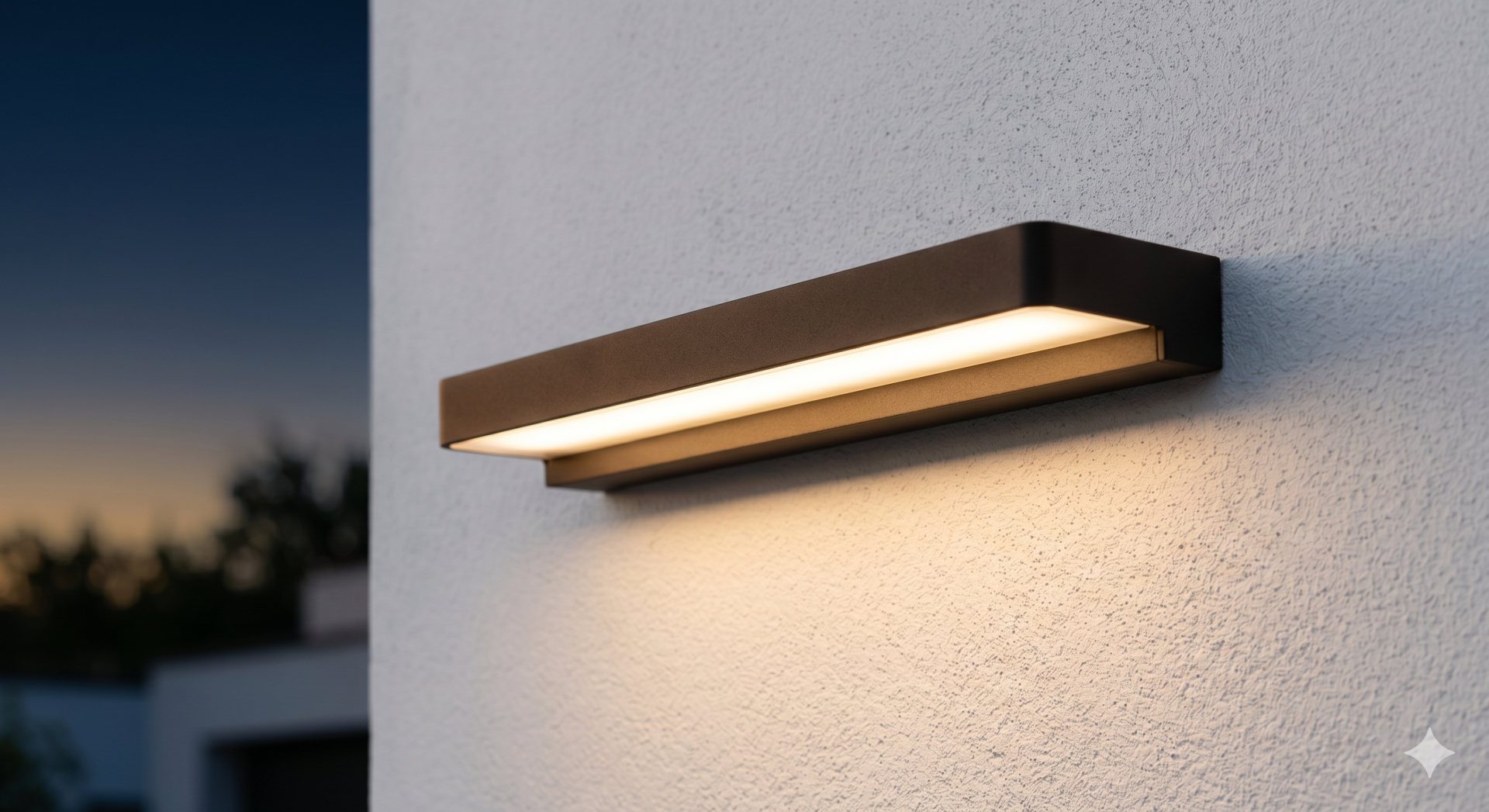
- Wall lights — placed symmetrically either side of a seating area
- String lights — for pergolas and covered seating, where the fitting is part of the mood
- Rechargeable table lamps — no cable, carried wherever you sit
Efficiency — LED, colour temperature and lasting well
LED outdoor lighting uses up to 80% less electricity than the halogen fittings it replaced, and lasts 25,000 to 50,000 hours. Beyond the running cost there is an aesthetic point that matters just as much: the colour temperature of the light decides whether a house looks warm or clinical after dark.
Colour temperature is measured in kelvin (K). For domestic outdoor lighting, the international guidance (IES and DarkSky International) points to 2700K to 3000K — a warm, soft white close to what an incandescent lamp used to give.
| Kelvin | Tone | Where it belongs |
|---|---|---|
| 2700K | Warm white | Terraces, pergolas, seating areas, warm materials such as brick and wood |
| 3000K | Soft white | Paths, facades, planting — the safe general choice |
| 4000K+ | Neutral to cool | Garages, parking, security areas — not around a house |
Use one colour temperature throughout a scheme. Mixing 2700K and 4000K fittings in the same space reads as a mistake even to someone who could not name what is wrong. Choose the tone that suits the materials and the architecture, and then keep to it everywhere.
Frequently asked questions
What IP rating does outdoor lighting need?
IP44 is the minimum for a covered terrace where a fitting might catch splashes. IP65 is the standard for exposed facades, paths and driveways — it withstands a direct jet of water. IP67 to IP68 is required for underwater fittings in fountains and ornamental ponds.
How far apart should bollard lights be along a path?
The usual spacing is 180–220 cm between fittings. A 10 m path therefore needs five or six bollards. Choose fittings with a wide beam angle (120 degrees or more) so the light overlaps and leaves no dark patches between them.
Which colour temperature suits a facade?
For traditional facades in brick, stone and warm tones, 2700K. For modern facades in concrete and glass, 3000K. Avoid 4000K and above on a house: cool light takes away exactly the quality that makes a home look like one.
Can LED strips be used outdoors?
Yes, but only with the right protection. For exposed positions look for IP65 strip with a polyurethane coating; for wet locations, IP67 or IP68. Standard indoor IP20 strip will not survive outdoors, whatever it is fixed to.
Is smart outdoor lighting worth it?
Generally yes. Smart systems give you remote control, automation and a record of what the lighting is using. The extra cost over a conventional installation usually pays for itself within two or three seasons through lower consumption alone, before counting the convenience.

 Varna,
 Mon – Sat 10:00 – 19:00